
- Why is PPC being implemented at our project?
- Who is SPS?
- What other projects have used PPC?
- What value can we expect from PPC?
- How does PPC deliver this value?
- What is the focus of the PPC Solution?
- Will the PPC Solution replace our existing Project Controls processes / systems?
- Who is the main user of the PPC Solution?
- What exactly gets implemented?
- Who implements the PPC Solution?
- Do SPS|TS come to manage my work and the project?
- Who is SPS|TS going to work with once onsite?
- What is the Solution Implementation process?
- What is the thirty-day plan for PPC Solution Implementation?
- How long does it take to get it implemented?
- When can we expect to start seeing the benefit?
- If I am a Superintendent, General Foreman or Foreman, what do I need to do on a daily basis as part of effectively using PPC?
- Are PPC Production Schedules going to replace our existing Master Schedule?
- Are we going to map all of the standard processes before we start Production Planning?
- Who needs to attend daily Production Planning sessions?
- If our Superintendents / Foremen are not in the field all the time, workers are not productive. Why do they need to attend daily Production Planning, and for how long?
- If we have Tool Box sessions (or similar) in the field every morning, do we need to discontinue them?
- What level of detail are we planning to?
- Who enters data in SPS|PM?
- Can the PPC Solution be implemented in a Lump Sum project?
- Can we easily identify constraints to our own work so they can be removed?
Q: Why is PPC being implemented at our project?
A: Chances are project leadership is looking to either compress the schedule duration, reduce the cost of the project or some combination of both, without compromising quality and safety standards. An often-overlooked area of opportunity for optimization is the management of work execution, specifically the design of work processes, allocation of resources and management of variability. PPC provides the framework for achieving all of the above.
Q: Who is SPS?
A: Founded in 2000, SPS is the globally recognized leading provider of PPC Solutions. SPS PPC Solutions have been deployed in support of a variety of project types around the world ranging in value from under $1 million to over $50 billion.
Q: What other projects have used PPC?
A: PPC has been used across a variety of industry sectors, ranging from oil & gas (major capital projects, onshore / offshore field development, turnarounds) to industrial (chemical plants, manufacturing plants) and infrastructure (airports, road construction and hospitals). Additionally, PPC has been implemented in shipbuilding and ship repair, software development, and various maintenance, repair and overhaul (MRO) projects.
Q: What value can we expect from PPC?
A: PPC reduces the risk of environmental, health and safety incidents while enhancing quality and providing more effective control of cost and time.
Q: How does PPC deliver this value?
A: PPC delivers the above value by reducing variability, and therefore enabling better use of resources (capacity, time and inventory).
Q: What is the focus of the PPC Solution?
A: The focus of the PPC Solution is work planning, execution and improvement. The focus is not to generate schedules to track progress or produce forecasts. However, this can be a by-product of effectively using the Solution.
Q: Will the PPC Solution replace our existing Project Controls processes / systems?
A: No. PPC processes and its enabling system augment the existing Project Controls processes and systems. As a matter of fact, customers oftentimes integrate PPC with their Project Controls solution.
Q: Who is the main user of the PPC Solution?
A: Since the focus of the PPC Solution is work planning, execution and improvement, the main Solution users are those directly responsible for planning and managing execution of work. This includes Superintendents, General Foreman and Foreman in the case of construction, commissioning and start-up, and Discipline Leads in the case of design and engineering production.
Q: What exactly gets implemented?
A: The PPC Solution consists of three processes, Production Planning, Production Scheduling and Continuous Improvement, each with associated rules and a set of non-traditional Performance Indicators. To ensure a sustainable and scalable Solution implementation and to support work optimization, the PPC Solution uses SPS|Production Manager (SPS|PM) as the enabling software system. What gets implemented are the processes outlined above through the use of SPS|PM.
Q: Who implements the PPC Solution?
A: The implementation of the PPC Solution is planned and coordinated by the SPS|Technical Services (SPS|TS) team. SPS|TS representatives will be allocated to your project to configure and deploy the PPC Solution. Members of the project team use the PPC Solution.
Q: Do SPS|TS come to manage my work and the project?
A: No. SPS|TS works with you and your colleagues to make PPC processes operational, so that a better and more robust approach to planning, controlling and improving work is in place. You still manage your project and the work.
Q: Who is SPS|TS going to work with once onsite?
A: SPS|TS will mainly work with those individuals directly responsible for the work, as they are the main users of the Solution. Additionally, interaction with Project Leadership and stakeholders should be expected throughout Solution deployment.
Q: What is the Solution Implementation process?
A: The Solution Implementation process consists of three main phases: 1) Configure, 2) Deploy and 3) Improve. Configure focuses on defining project-specific parameters associated with how work is done. For instance, work calendars, work structures, how teams are organized and who belongs to each team, disciplines / trades involved, contractors, infrastructure requirements, as well as SPS|PM user administrative levels. Deploy consists of two parts: Prepare and Initiate. Prepare involves planning for Solution deployment. This includes establishing a deployment process, sequence, schedule, meeting calendars, testing the required infrastructure, roles and responsibilities, escalation process and communication protocols. During Initiate, we begin deployment of the base PPC processes, Production Planning and Production Scheduling. Improve will start 4 to 6 weeks after Production Planning and Production Scheduling are in place, to allow for the generation of enough relevant data to assess project production performance using Performance Indicators.
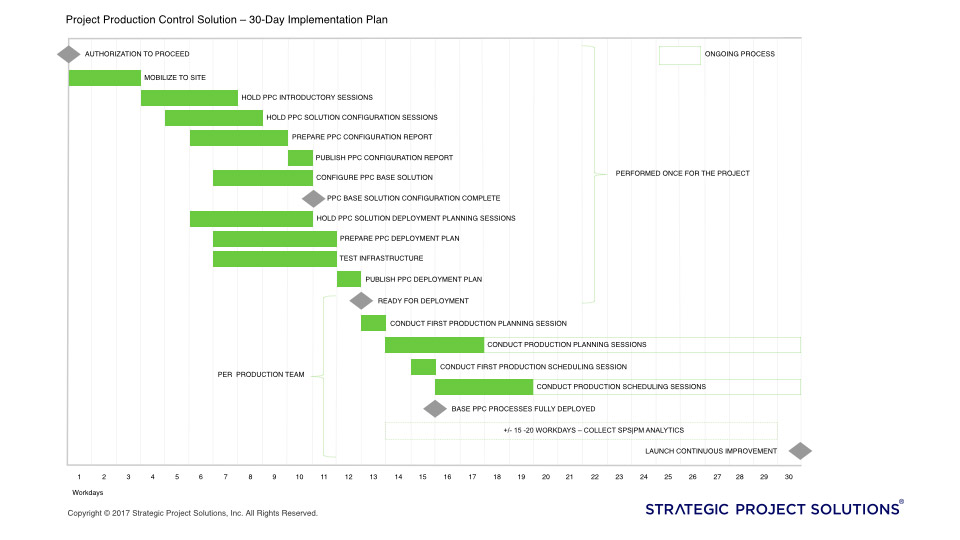
Q: What is the thirty-day plan for PPC Solution Implementation?
A: During the initial thirty days of implementation, the goal is to complete Solution configuration including deployment planning, as well as to launch Production Planning and Production Scheduling. Depending on specific project conditions, Continuous Improvement can start within the first thirty days, but in most cases, the first thirty days are focused on building the foundation for sustainable and scalable Solution deployment.
Q: How long does it take to get it implemented?
A: As depicted in the above thirty-day plan, base PPC processes are fully deployed after three weeks from formal kick-off. However, Production Planning can start immediately after mobilizing to site.
Q: When can we expect to start seeing the benefit?
A: The PPC Solution will start exposing opportunities for optimization from the moment the PPC base processes are operational and performed without interruptions.
Q: If I am a Superintendent, General Foreman or Foreman, what do I need to do on a daily basis as part of effectively using PPC?
A: A standard PPC Solution Implementation requires that project teams adopt the following weekly calendar for PPC processes:
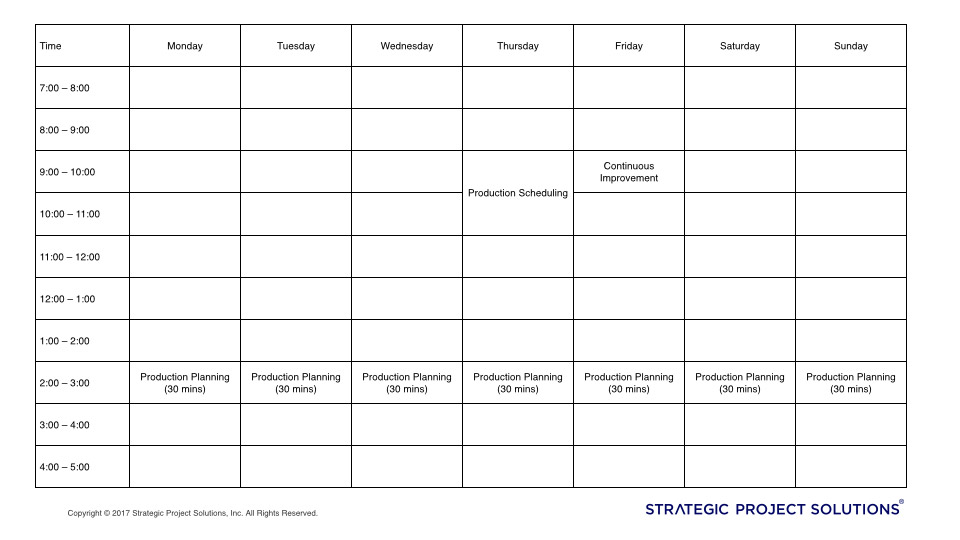
Although the above times are examples, in cases where Solution configuration indicates the need to perform daily Production Planning (e.g., in engineering, Production Planning can be done weekly rather than daily), it is highly recommended to schedule and conduct Production Planning in the afternoons in order to plan for the following day, rather than in the mornings planning for the same day. This allocates enough time to fully prepare for next day. If work is executed based on shifts (e.g., day and night shift), Production Planning can be conducted at the shift change.
Q: Are PPC Production Schedules going to replace our existing Master Schedule?
A: No. Master Schedules, typically created in Oracle Primavera P6, MS Project or any other scheduling software, provide a start to end view of the project and represent the main tool used for reporting and forecasting overall project progress. Production Schedules focus on a much shorter time frame and are intended to establish clear work execution processes, including handoffs and task durations that match the agreed control cycle.
Q: Are we going to map all of the standard processes before we start Production Planning?
A: No. Mapping all standard processes in advance does not work and is never the preferred approach. Standard Processes are identified and captured as work progresses, with input from those directly responsible for the work. Therefore, in many cases, mapping all standard process in advance is not possible, as those that are responsible for the work may not have mobilized to the project. The SPS|PM Standard Process Library is used to compile all standard processes as they are identified. Standard Processes can then be used to rapidly generate Production Schedules for execution.
Q: Who needs to attend daily Production Planning sessions?
A: Individuals directly responsible for the work need to attend, as well as those who decide the allocation of capacity (labor, equipment and use of space).
Q: If our Superintendents / Foremen are not in the field all the time, workers are not productive. Why do they need to attend daily Production Planning, and for how long?
A: Integration of work across disciplines / trades is critical to ensure capacity is used effectively. Supervisory Personnel are expected to participate in a daily Production Planning process for sessions lasting 30 minutes max. As teams learn the business processes, policies and supporting tools, initial sessions may take longer, but no more than one hour.
Q: If we have Tool Box sessions (or similar) in the field every morning, do we need to discontinue them?
A: No. The idea is to have daily Production Planning sessions in the afternoons and to commit a Production Plan for the next day of work. Tool Box sessions are meant to be short standing sessions in the field for Superintendents / General Foremen to communicate the plan for day to Foremen / Crew Leads, including addressing safety concerns. Production Planning and Tool Boxes complement each other.
Q: What level of detail are we planning to?
A: Although requirements may differ from project to project or even from project phase to project phase, simple rules for how to determine the required level of detail for Production Schedules are: 1) provide enough detail to clearly understand how work is handed over between disciplines / trades (focus on handoffs) and 2) to the extent possible, define workflows with durations that match the agreed control cycle (e.g., if we commit daily production plans, the expectation is to define workflows with task durations equal or lower than one day).
Q: Who enters data in SPS|PM?
A: Most PPC Solution deployments are structured with the use of Advanced Users who act as Recorders during Production Planning and Production Scheduling sessions. Individuals in these positions are the ones responsible for entering data in SPS|PM.
Q: Can the PPC Solution be implemented in a Lump Sum project?
A: Yes. The PPC Solution will enable schedule optimization under this type of contract. A Lump Sum contract does not eliminate work complexity and the need for integration and optimization.
Q: Can we easily identify constraints to our own work so they can be removed?
A: Yes. The PPC Solution incorporates a process called Constraints Analysis. During Production Scheduling sessions, those directly responsible for the work can identify any type of constraint to their work, whether they are physical (e.g., “I cannot start work in this area until this other work is fully completed) or non-physical (e.g., “We need a permit to start this work”). As constraints are identified, they are incorporated into the Production Schedules as tasks, with a person responsible for removing the constraint assigned to the task. Because variability exists on every project, typically not all constraints, especially those associated with shared equipment, tools and space, are identified in advance. This is why Production Planning is a process designed to identify last-minute constraints and then remove them, to avoid stopping the flow of work.
If you have additional questions, please contact support@spsinc.net or call +1 (415) 362-3200.